Marble and natural stone
Mineralogy and finish determine the abrasive and polishing approach.

Renovation Service · Miami
Service guide
Livane Renovation polishes suitable marble, terrazzo, natural stone and concrete floors across South Florida using methods specific to each material. Floor polishing refines the surface to improve clarity, sheen and uniformity, but it is not one universal process. Marble polishing follows stone-specific honing and polishing chemistry, terrazzo is progressively refined according to its matrix, and concrete polishing uses a distinct grinding and densification system when suitable.
Identify material and current finish.
Inspect wear, contamination, repairs and edges.
Test the response where the finish is uncertain.
Protect adjacent surfaces and organize access.
Clean and complete required preparatory refinement.
Polish with the material-specific sequence.
Apply compatible protection only when appropriate.
Review uniformity and maintenance requirements.
Mineralogy and finish determine the abrasive and polishing approach.
Matrix type, aggregate and old coatings shape the sequence.
Concrete polishing may include grinding and densification and should not be confused with stone crystallization.
Perimeters and corners have different tool access and should be included explicitly in finish expectations.
Polishing suits a surface that mainly needs finish refinement. Deeper scratches, etching, coatings or repairs usually expand the work into restoration.
The right sheen depends on material, lighting, traffic and maintenance—not simply the highest possible gloss.
No. Stone, terrazzo and concrete require different tools, consumables and decision criteria.
No responsible scope can be priced from the service name alone. The principal project variables are:
Often, if dullness is surface-level and the material is suitable. Testing distinguishes polishing from deeper restoration.
Light wear may improve, while deeper scratches generally require corrective honing or grinding.
There is no universal interval; traffic, maintenance, material and finish expectations determine timing.
No. Polishing may make surrounding finish uniform but cannot guarantee invisible patches.
Yes, though transitions and consistent finish between phases need planning.
Provide wide reflected-light photos and close-ups of scratches, edges, repairs and traffic lanes.
Share clear photos, approximate square footage, the property location, current condition and desired result. That information helps separate a preliminary conversation from work that needs a site review.
Commercial floor polishing in Miami transforms ordinary concrete, stone, and terrazzo surfaces into highly durable, light-reflective assets capable of handling intense daily traffic. In the active retail, corporate, and hospitality sectors of South Florida, a properly polished floor provides a clean, architectural finish without the need for topical coatings or waxes that inevitably peel, scratch, or wear away over time.
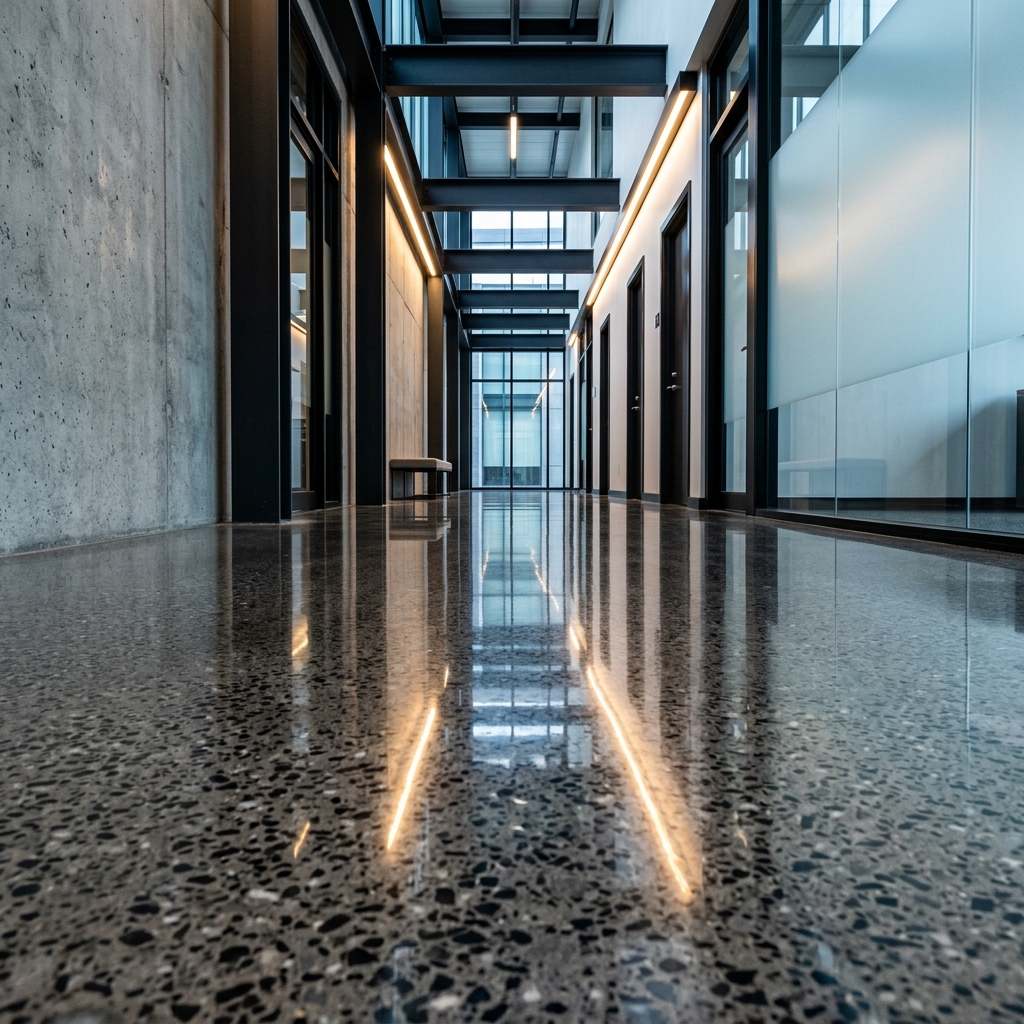
The core of our process relies on heavy-duty planetary grinders equipped with industrial diamond abrasives. We mechanically refine the surface through progressive grit stages, simultaneously densifying the material to increase its abrasion resistance and lock out contaminants. This structural enhancement results in a permanent improvement to the floor's surface density and longevity.
For property teams and property owners and managers, polished floors offer one of the lowest lifecycle costs of any commercial flooring option. The densified surface significantly reduces concrete dusting, lowers daily janitorial requirements, and delivers a premium aesthetic that easily withstands the rigors of heavy commercial use without constant restorative maintenance.
Floor polishing is often the final step in a comprehensive floor restoration project. Whether we are reviving an aging terrazzo lobby or upgrading an industrial concrete warehouse, our polishing techniques provide a seamless, high-performance finish. We regularly coordinate this work alongside our floor polishing schedules to ensure the full property is properly protected.
We approach every floor based on its unique structural integrity. Not all slabs can achieve a high-gloss finish immediately. We thoroughly assess the existing hardness, aggregate exposure, and prior damage to determine the exact diamond tooling sequence required to achieve the most durable and visually striking result possible.
Multi-stage mechanical diamond grinding, structural patching, application of lithium-based chemical densifiers, fine-grit resin polishing, and the application of penetrating, burnished stain guards to protect against liquid intrusion.
Big-box retail stores, logistics and distribution centers, corporate office lobbies, educational institutions, automotive showrooms, and high-traffic hospitality venues throughout South Florida.
We start by aggressively grinding the surface to remove existing imperfections, stains, or failing coatings. We then apply a densifying agent that reacts chemically with the substrate to permanently harden the surface. Finally, we mechanically polish the floor to the specified gloss level and burnish a protective micro-guard.
Polishing physically changes the structure of the floor surface, making it harder and more resilient. It eliminates the need for expensive, recurring stripping and waxing cycles, significantly reducing ongoing maintenance costs while improving ambient light reflection and property safety.
We don't use generic polishing pads or skip critical grit stages. Our work is entirely condition-based; we evaluate the hardness of your specific floor and adjust our grinding sequence to ensure a permanent, contractor-grade polish rather than a temporary shine.
Floor polishing can be scheduled alongside epoxy systems in service areas, carpet replacement in offices, and finish millwork when a property is being repositioned.