Floor appearance carries more weight in commercial properties than many teams initially assume. It affects first impressions, perceived building quality, tenant experience, and how well a space holds up under daily traffic. In South Florida, that conversation often starts with a broad request for floor polishing, but in many properties the real need is more specific: marble polishing.
For property managers, facility teams, building owners, and commercial operators, that distinction matters. Floor polishing is a broad service category. Marble polishing is a material-specific process with different technical requirements, finish expectations, and maintenance considerations. Livane’s own SEO and service-positioning work also points in that direction: broad floor polishing terms attract attention, but restoration- and material-specific topics tend to align better with serious service intent and higher-value commercial demand.
What Is Floor Polishing?
Floor polishing is a broad term used for improving the appearance, clarity, and finish level of a hard floor surface through mechanical refinement, cleaning, and in some cases protective treatment. On a commercial property, that might involve concrete, marble, terrazzo, or other hard surfaces depending on the building and existing floor type.
That broad framing is important because “floor polishing” is often used as a catch-all request even when the correct process depends entirely on the material. Livane’s business profile also treats floor polishing and restoration as a specialty commercial category rather than a routine janitorial task, which is the right commercial positioning for serious projects.
In practical terms, commercial buyers usually ask for floor polishing when they are trying to solve one or more of these problems:
- dull-looking floors despite regular cleaning
- visible traffic wear in lobbies, corridors, or common areas
- loss of reflectivity or finish quality
- surface haze, light scratching, or uneven sheen
- a floor that makes the space feel older than it is
What Is Marble Polishing?
Marble polishing is a more specific process used to refine and enhance marble surfaces by reducing surface dullness, improving clarity, and restoring reflectivity. It is not just “polishing a floor.” It is a stone-specific service that has to account for marble’s composition, sensitivity, finish level, and existing condition.
That distinction matters because marble behaves differently from concrete or many other hard surfaces. If the floor has etching, embedded wear, or loss of finish, the correct solution may require more than a simple polishing pass. In many marble projects, the decision is not only whether to polish, but whether the floor needs honing, restoration, stain treatment, repair, or sealing as part of the scope.
Floor Polishing vs. Marble Polishing
Floor polishing is a category
Floor polishing describes the outcome the client wants: a cleaner, more refined, more professional-looking floor. It is broad, commercial, and often used at the estimating stage before the actual substrate is evaluated.
Marble polishing is a material-specific process
Marble polishing is one subset within that larger category. It requires a process built specifically around natural stone, not a generic hard-floor approach.
One request can lead to two different scopes. A property manager may ask for floor polishing, but once the surface is reviewed, the real scope may turn out to be marble polishing, marble honing and polishing, full marble restoration, cleaning plus sealing, or localized repair plus finish correction.
That is one reason disciplined quoting matters. Livane’s operating model emphasizes photo review, square footage, and site evaluation when needed, because the visible condition and material type change the real scope.
Where These Services Are Commonly Used
General floor polishing
Commercial floor polishing is commonly considered for:
- office common areas
- retail floors
- institutional interiors
- showroom spaces
- building corridors
- commercial entries and reception areas
Marble polishing
Marble polishing is more likely to be relevant in:
- lobby floors
- elevator lobbies
- high-end office interiors
- hospitality-adjacent commercial spaces
- executive suites
- premium common areas in mixed-use or multi-tenant buildings
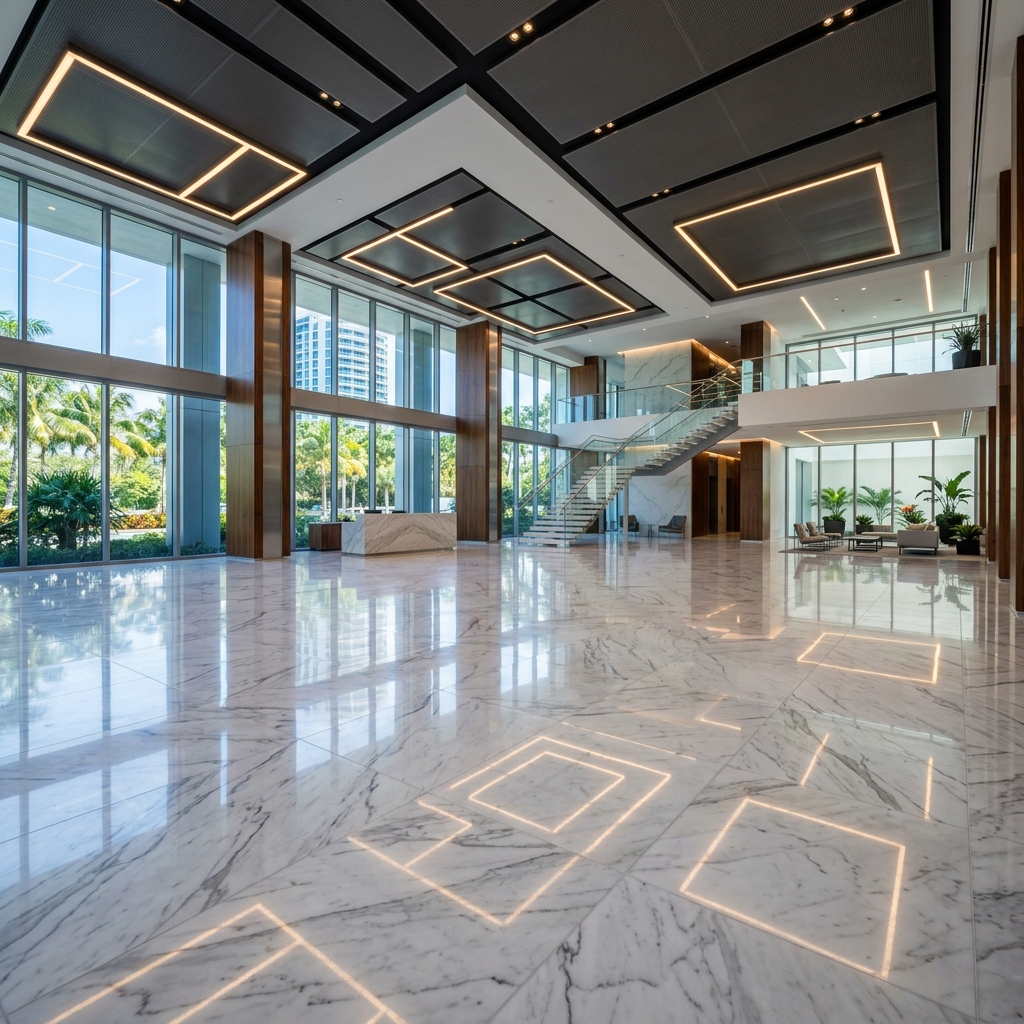
In South Florida, marble remains a common surface in spaces where visual quality matters. When those areas lose clarity or start to look worn, general cleaning will not solve the problem.
Common Problems Commercial Clients See
Dull finish that no longer reflects light
This is one of the most common complaints. The floor may be technically clean, but still look tired.
Traffic wear in high-use paths
Main walk lines often lose finish first, especially in entrances, corridors, and reception areas.
Surface haze or uneven sheen
This makes a floor look poorly maintained even when the issue is really wear, not dirt.
Light scratching and visible abrasion
Furniture movement, foot traffic, and routine use gradually reduce clarity.
Misdiagnosed “dirty floor” problems
Some floors are not dirty. They are worn, etched, or physically degraded at the surface level. That is why restoration-oriented service positioning makes more sense than commodity cleaning language for these categories.
The Process: What Commercial Buyers Should Expect
1. Surface and material evaluation
The first step is identifying exactly what the floor is and what condition it is in. A marble floor with etching and wear is not scoped the same way as a durable concrete or terrazzo surface.
2. Condition-based recommendation
The right recommendation depends on what is actually happening on the floor. Is it just low sheen? Is there etching? Is there embedded wear? Is the issue cosmetic, or has the surface degraded enough to require a more corrective process?
3. Mechanical refinement
For both floor polishing and marble polishing, the finish is improved through controlled mechanical work. But the tooling, sequence, and finish target differ based on the material.
4. Optional protection stage
Depending on the surface and environment, sealing or protective treatment may be part of the scope, especially when long-term presentation and maintenance are priorities.
5. Final appearance review
Commercial projects should end with a clear finish standard, not a vague “looks better” result. The client should know what level of sheen, clarity, and improvement is being delivered.
When Polishing Is Enough and When Restoration Is the Better Call
This is where many projects go wrong.
Polishing may be enough when
- the surface is structurally sound
- wear is relatively light
- the main issue is reduced visual clarity
- there is no major etching, deep scratching, or widespread damage
Restoration is usually the better path when
- the marble has visible etching or deeper wear
- the floor has uneven finish areas
- traffic lanes are heavily degraded
- the surface needs correction before any final polish can hold visually
- the client wants a true improvement, not a temporary appearance boost
This also aligns with the broader SEO and service strategy behind the brand: restoration topics tend to map better to serious commercial intent than broad, generic polishing language alone.
Planning Considerations for Commercial Properties
Occupied buildings
If the property is active, noise, access, dust control, and work windows need to be discussed early.
Surface area and phasing
Large spaces often need to be phased so the property remains usable during the work.
Expectations on finish level
Not every client wants the same result. Some want a refined satin look. Others want higher reflectivity. The target finish should be defined before work starts.
Existing maintenance issues
A floor that has been maintained inconsistently may need more correction than expected. That affects timing and pricing.
What Typically Drives Cost
Exact pricing depends on the actual condition and scope, but the main cost drivers are straightforward:
- floor material
- total square footage
- existing damage or wear level
- whether restoration is required before polishing
- access and scheduling constraints
- occupied vs. unoccupied site conditions
- whether sealing or related surface work is included
For commercial buyers, the biggest mistake is comparing one “polishing” quote against another without confirming whether both vendors are pricing the same actual scope.
Mistakes to Avoid
- Using a generic polishing request without identifying the material. That often produces weak estimates and mismatched scopes.
- Assuming regular cleaning and polishing are the same thing. They are not. A worn marble floor will not recover through normal maintenance alone.
- Choosing only on price. Low numbers often leave out correction work, protection, or realistic labor assumptions.
- Ignoring whether the floor needs restoration first. If the substrate needs corrective work, skipping that step usually leaves the client disappointed with the finish.
- Treating premium surfaces like commodity floors. Marble is not a generic hard floor. The process has to reflect that.
Who This Service Is Best For
This type of work is best suited to:
- property managers trying to improve presentation in common areas
- facility managers dealing with visible wear in active buildings
- building owners protecting higher-end interior finishes
- general contractors needing a finish-stage floor improvement partner
- commercial operators upgrading the appearance of client-facing spaces
That audience also matches how Livane is positioned overall: as a South Florida renovation services company focused on surface improvement, restoration, and disciplined project support rather than basic cleaning.
FAQ
Is marble polishing the same as floor polishing?
No. Floor polishing is a broad category. Marble polishing is a material-specific process used for marble surfaces.
How do I know if my marble floor needs polishing or restoration?
If the main issue is light dullness, polishing may be enough. If you see etching, uneven wear, traffic damage, or loss of surface quality, restoration may be the better scope.
Can a dull marble floor look better without full replacement?
Yes. In many cases, the issue is surface condition, not the need for replacement.
Is this mainly for residential properties?
No. This type of work is highly relevant for commercial lobbies, office common areas, premium interiors, and other presentation-sensitive spaces.
Do you need photos before quoting?
Usually, yes. Photos, measurements, and a short description of the current condition help narrow the scope before a site visit. That is also part of Livane’s stated quoting approach.
If you are evaluating floor polishing or marble polishing for a commercial property in Miami, Fort Lauderdale, Boca Raton, or the broader South Florida market, the best first step is to send photos, approximate square footage, and a short description of the floor’s current condition.
Livane Renovation can review the surface, clarify whether the right scope is polishing or restoration, and provide a more accurate recommendation based on the actual material and site conditions.